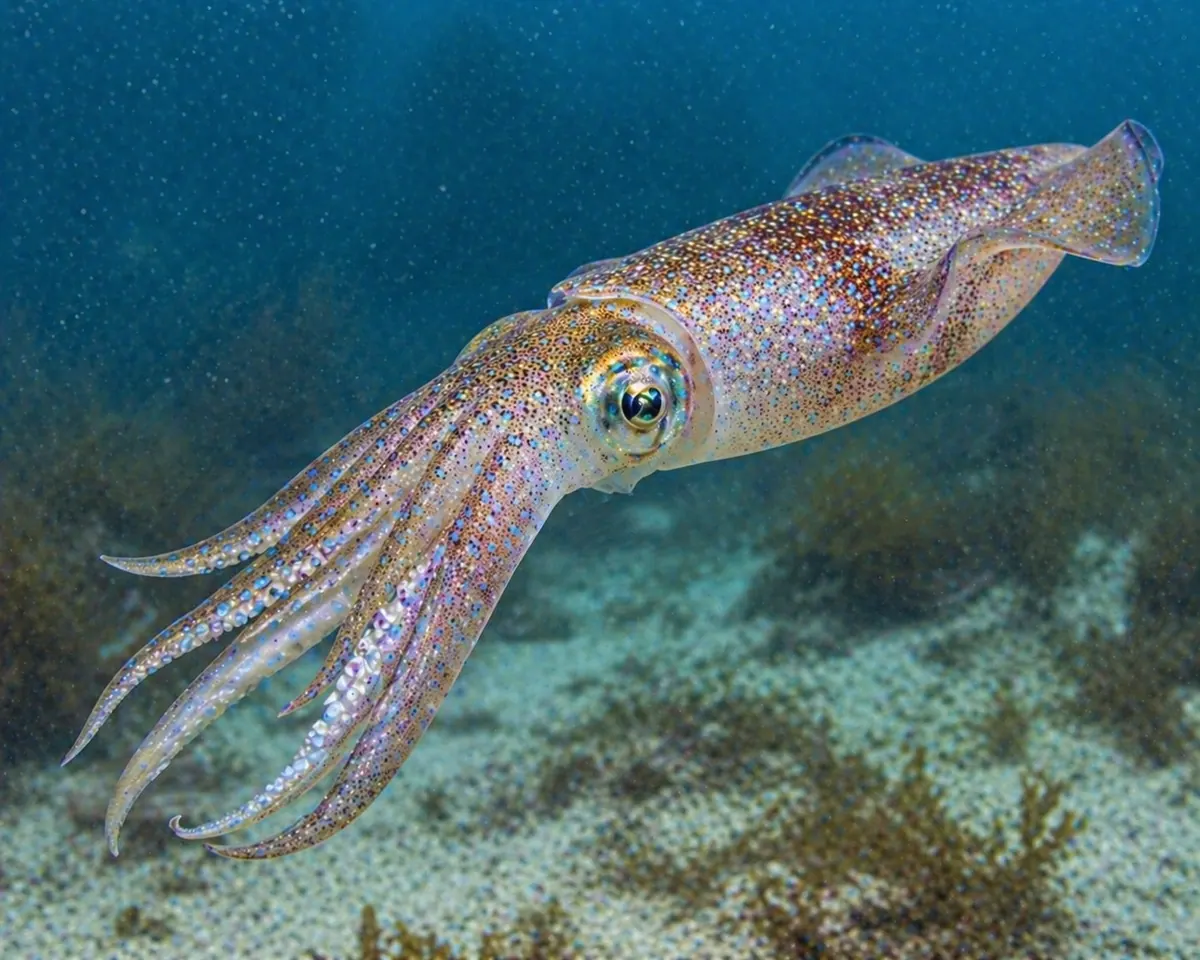
All speciesThe premium squid

Southern Calamari

Australia's southern calamari (squid) is hand-jigged from coastal waters across SA, VIC, and TAS. Prized over imported squid for its tender flesh and clean flavour.

Sepioteuthis australis
Flavour: Tender, sweet, light brine — vastly superior to imported squid
Sustainable· SAFS 2024
Southern Calamari (Sepioteuthis australis)

Four reasons to choose local

Health

  • Hand-jigged — no chemical treatment
  • Pristine cold-water flesh
  • Strong protein, selenium, and copper content

Economy

  • Important small-boat hand-jigging sector
  • Spencer Gulf, Port Phillip, and Tasmanian coast fleets
  • Premium pricing supports family-scale operators

Environment

  • Hand-jigged — zero bycatch and minimal disturbance
  • Fast-growing species with healthy stock
  • Targeted harvest with small, selective gear

Taste

  • Astonishing tenderness vs frozen imported squid
  • Sweet, clean — great raw, seared, or grilled
  • The benchmark calamari salt-and-pepper

Sourcing

Southern Calamari is exclusively wild-caught.

Where it comes from

Southern Calamari is most strongly associated with these 5 Australian regions:

How it's caught or grown

Production volume (last 5 years)

Total Australian annual production of Southern Calamari — wild-catch + aquaculture combined. Sourced from ABARES Australian Fisheries and Aquaculture Statistics.

Production volume (tonnes)Source: ABARES
20196002020580202162020227002023750
primary estimate

How it's managed

Effort-managed across multiple state fisheries.

Nutrition (per 100g)

How Southern Calamari compares to imported equivalents on the headline nutrients consumers care about.

Protein18.4g15.8g
Selenium44µg30µg
Omega-3 Fatty Acids540mg320mg
Vitamin B121.3µg0.9µg
Copper1.9mg1.4mg

Contaminants & price

Australian Southern Calamari compared to imported equivalents on mercury, antibiotic residues, and typical retail price. Unflagged metrics come from primary government sources (FSANZ, ABARES); synthesised numbers carry a visible tag.

Metric
Australian
Imported
Mercury (mg/kg)
0.02
0.04
Antibiotic residues
none
rare
Typical retail price (2026 Q1)editorial
$22–38/kg
$12–18/kg

From harvest to plate

Days-to-plate is one of the strongest arguments for buying Australian. Here's the typical timeline for Southern Calamari.

  1. Step 1
    Hand-jig catch
    Day 0 days
  2. Step 2
    Onshore chill
    0–1 days
  3. Step 3
    Wholesale
    1–2 days
  4. Step 4
    Retail / restaurant
    2–3 days
  5. Total
    Total AUS days to plate
    2–3 days

Seasonality

When to enjoy Southern Calamari at its peak.

Janavailable
Febavailable
Maravailable
Apravailable
Mayavailable
Junavailable
Julavailable
Augavailable
Sepavailable
Octavailable
Novavailable
Decavailable
Peak Good Available Off-season

How to cook it

Four go-to preparations for Southern Calamari that respect the fish — short cooks, clean flavours, no over-doing it.

Salt and pepper

Cornflour-dusted rings, deep-fry 90 sec, sea salt + chilli + spring onion.

Sashimi

Cleaned tube, score the inside, slice thin — soy + ginger + sesame.

Char-grilled

Whole tubes, hot grill 60 sec each side, lemon + chilli + parsley.

Stuffed and braised

Tube stuffed with rice + herbs, braise in tomato sauce 30 min.

Full recipe: Salt & Pepper Calamari

Australian vs imported — at a glance

Hand-jigged Southern Calamari vs frozen imported squid rings — completely different products in flavour and texture.

Australia
Australian Southern Calamari
SA / VIC / TAS
🇦🇺 Local
Catch methodHand-jigged
Chemical tenderisingNone
Bleach in processingNone
Frozen-thawed cyclesMinimal
Price per kg~$30
Overall rating: Southern Calamari scores 9.2/10 — tender, fresh, hand-jigged.
vs
Asia
Imported Squid
China / Vietnam / Thailand
Catch methodIndustrial trawl
Chemical tenderisingCommon
Bleach in processingReported
Frozen-thawed cyclesMultiple
Price per kg~$15
Overall rating: Imported Squid scores 5.0/10 — bleached, treated, generic.

Read the full comparison →

Look-alikes & how to tell them apart

Products often confused with or substituted for Australian Southern Calamari — and what to look for instead.

Imported squid rings (China, Vietnam, Thailand)
Why confused: Frozen IQF rings dominate retail and foodservice.
How to tell: Australian Southern Calamari has thick, sweet, very-tender flesh and is sold whole or in tubes. Frozen rings are often industrial trawl-caught and chemically treated.
Arrow squid (Nototodarus gouldi)
Why confused: Different species; tougher flesh; cheaper.
How to tell: True calamari has fins running the full length of the body; arrow squid fins are limited to the rear third.

The risks of the imported version

Typically imported from: China, Vietnam, Thailand, India

  • Imported squid often bleached or chemically tenderised
  • Mass-produced rings are typically lower-grade species
  • Frozen-thawed cycles ruin tender hand-jigged textures

See the full case against imported seafood →

How to buy it

🔍
Look for:

Ask for "Australian Southern Calamari" — frozen rings are usually imported.

From 1 July 2026, every restaurant menu in Australia must show A (Australian), I (Imported), or M (Mixed) for each seafood dish. Read the law →

Key operators, co-ops & peak bodies

The businesses, co-operatives, and industry bodies behind Australian Southern Calamari.

Historical timeline

  1. 1990
    Southern Calamari hand-jig fishery formalised in Victoria.
  2. 2015
    Marketing as premium 'calamari' (vs imported squid) gains traction.

Sources for this page

  1. SAFS 2024 Fisheries Research and Development Corporation (2024)

Explore other Australian species

Scroll to browse. Each card links to a full species profile.