All speciesSpencer Gulf premium

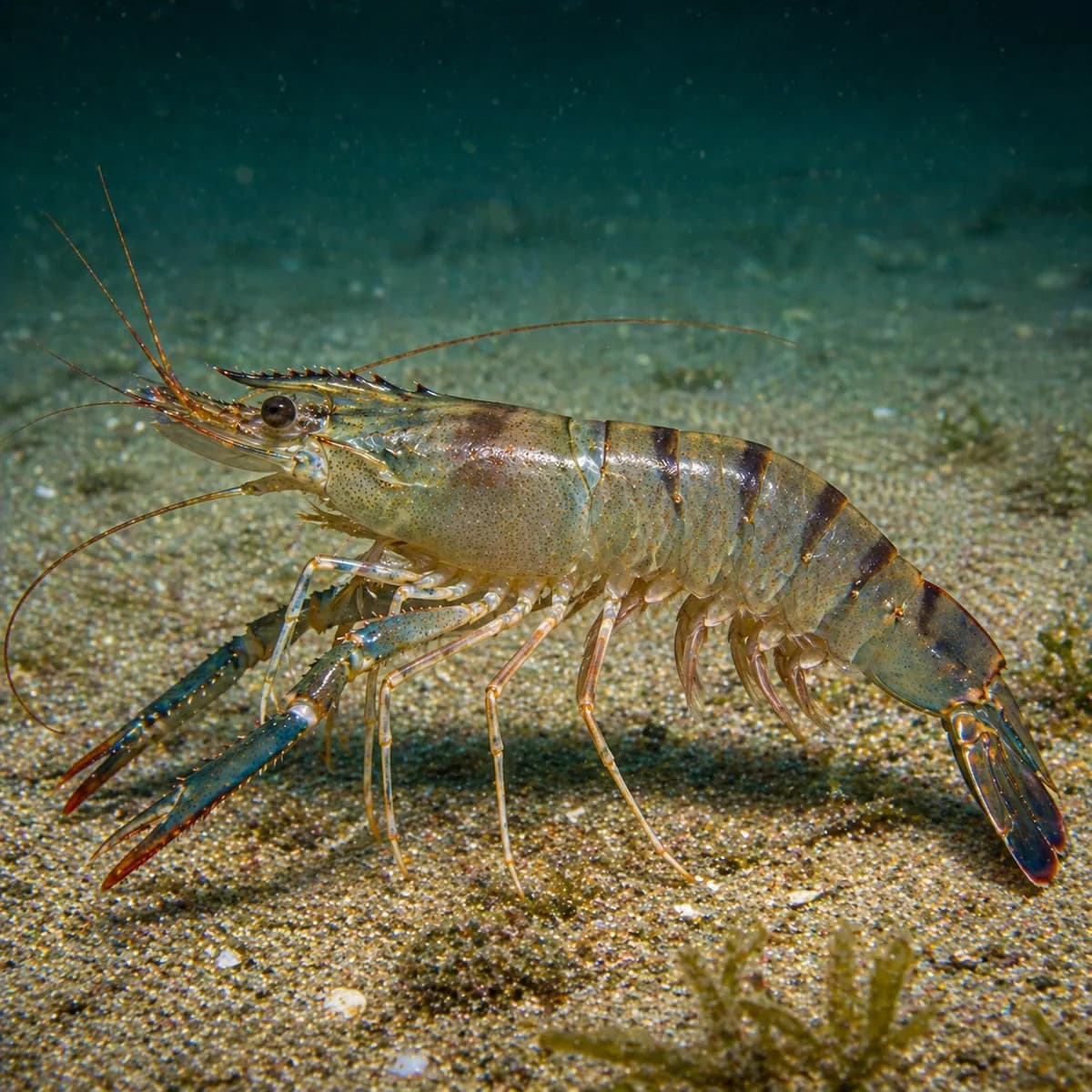
King Prawns

The wild-caught Western King Prawn from South Australia's Spencer Gulf is widely regarded as one of the world's finest — clean, sweet, and on a tightly-managed quota.

Melicertus latisulcatus
Flavour: Sweet, briny, with a snap when fresh — the benchmark Aussie prawn
Sustainable· SAFS 2024
King Prawns (Melicertus latisulcatus)

Four reasons to choose local

Health

  • No sulphites required — natural sodium levels only
  • Zero antibiotic exposure — wild-caught from clean Gulf waters
  • High-quality protein with iodine and B12

Economy

  • Eyre Peninsula towns built on the prawn fleet
  • 39 licensed Spencer Gulf vessels — tightly capped
  • Major export earnings fund the science underpinning quotas

Environment

  • Bycatch Reduction Devices and TEDs mandatory in trawls
  • Seasonal closures protect spawning aggregations
  • Independently assessed as sustainable

Taste

  • Snap-frozen on board to lock in sweetness
  • Distinctive briny finish from clean Gulf waters
  • The benchmark by which other prawns are judged

Sourcing

King Prawns is exclusively wild-caught.

Where it comes from

King Prawns is most strongly associated with these 4 Australian regions:

How it's caught or grown

Production volume (last 5 years)

Total Australian annual production of King Prawns — wild-catch + aquaculture combined. Sourced from ABARES Australian Fisheries and Aquaculture Statistics.

Production volume (tonnes)Source: ABARES
201921,000202019,500202123,000202222,500202324,000
primary estimate

How it's managed

Quota:3,000t

Spencer Gulf is effort-managed (limited boat-nights); NPF has fleet caps and gear restrictions. BRDs mandatory.

Nutrition (per 100g)

How King Prawns compares to imported equivalents on the headline nutrients consumers care about.

Protein18.6g17.2g
Selenium33µg24µg
Iodine35µg22µg
Zinc1.6mg1.2mg
Vitamin B121.8µg1.3µg

Contaminants & price

Australian King Prawns compared to imported equivalents on mercury, antibiotic residues, and typical retail price. Unflagged metrics come from primary government sources (FSANZ, ABARES); synthesised numbers carry a visible tag.

Metric
Australian
Imported
Mercury (mg/kg)
0.03
0.04
Antibiotic residues
none
documented
Typical retail price (2026 Q1)editorial
$35–65/kg
$16–28/kg

From harvest to plate

Days-to-plate is one of the strongest arguments for buying Australian. Here's the typical timeline for King Prawns.

  1. Step 1
    Catch (trawl at sea)
    Day 0 days
  2. Step 2
    Freeze at sea / chill
    0 days
  3. Step 3
    Port unloading & grading
    0–1 days
  4. Step 4
    Wholesale
    1–2 days
  5. Step 5
    Retail / foodservice
    2–3 days
  6. Total
    Total AUS days to plate
    2–3 (fresh) / frozen-at-sea (FAS) days

Seasonality

When to enjoy King Prawns at its peak.

Janavailable
Febavailable
Margood
Aprgood
Maypeak
Junpeak
Julpeak
Augpeak
Seppeak
Octpeak
Novgood
Decavailable
Peak Good Available Off-season

How to cook it

Four go-to preparations for King Prawns that respect the fish — short cooks, clean flavours, no over-doing it.

Raw (sashimi)

Spencer Gulf prawns sashimi-grade — peel, devein, dress with lime + chilli.

BBQ shell-on

Drizzle with olive oil + salt, hot grill 90 sec each side, finish with lemon.

Garlic butter

Peeled, hot pan, butter + lots of garlic + parsley, 2 min total. Crusty bread.

Salt & pepper

Cantonese-style: corn-flour dust, deep fry 2 min, toss with chilli + spring onion.

Full recipe: Spencer Gulf King Prawns with Garlic Butter

Australian vs imported — at a glance

Australian wild King Prawns from Spencer Gulf vs farmed imported prawns from Vietnam, India, and China.

Australia
Spencer Gulf King Prawns
South Australia
🇦🇺 Local
Protein (per 100g)18.6g
Sodium LevelNatural
Preservatives AddedNone
Antibiotic ResiduesZero tolerance
Farming StandardsStrict regulation
TraceabilityFull chain
Price per 100g~$5.00
Overall rating: Spencer Gulf King Prawns score 9.5/10 — globally recognised as among the world's finest.
vs
Asia
Imported Prawns
Vietnam / India / China
Protein (per 100g)17.2g
Sodium LevelOften elevated
Preservatives AddedSulphites common
Antibiotic ResiduesSometimes detected
Farming StandardsVariable
TraceabilityLimited
Price per 100g~$2.50
Overall rating: Imported prawns score 5.2/10 — significant variation in quality, additives, and ethics.

Read the full comparison →

Look-alikes & how to tell them apart

Products often confused with or substituted for Australian King Prawns — and what to look for instead.

Imported Vannamei (whiteleg) prawns
Why confused: Pond-farmed in SE Asia. Visually similar once peeled.
How to tell: Australian prawns are almost always sold shell-on with intact head. Imports are typically peeled, deveined, frozen IQF. Labels must state origin.
Imported Black Tiger prawns
Why confused: Same species (Penaeus monodon) as farmed AUS Black Tigers.
How to tell: Australian product displays origin prominently and typically sells fresh-chilled. Imported is almost always frozen.

The risks of the imported version

Typically imported from: Vietnam, India, China, Thailand

  • Sulphite preservatives — major allergen, mandatory disclosure when used
  • Antibiotic and antifungal residues regularly detected at the border
  • Pond construction has driven mangrove loss across SE Asia
  • Documented forced-labour cases in parts of the Thai supply chain

See the full case against imported seafood →

How to buy it

🔍
Look for:

Look for "Wild Australian Prawn" with a region — Spencer Gulf, Exmouth, Shark Bay, Banana Prawn (Gulf of Carpentaria).

From 1 July 2026, every restaurant menu in Australia must show A (Australian), I (Imported), or M (Mixed) for each seafood dish. Read the law →

Key operators, co-ops & peak bodies

The businesses, co-operatives, and industry bodies behind Australian King Prawns.

Historical timeline

  1. 1970
    Northern Prawn Fishery (NPF) established as Commonwealth-managed fishery.
  2. 1980
    Spencer Gulf prawn fishery begins industrial-scale trawl operations.
  3. 2000
    Bycatch Reduction Devices (BRDs) progressively mandated across all trawl fleets.
  4. 2012
    NPF achieves MSC certification for Banana Prawn components.
  5. 2019
    White spot outbreak in SE QLD ponds prompts biosecurity crackdown on imported raw prawns.

In the news

Sources for this page

  1. FSANZ chemical residues Food Standards Australia New Zealand (2024)
  2. FAO mangrove assessment Food and Agriculture Organization of the UN (2023)
  3. AP seafood-from-slaves investigation Associated Press (2015)

Explore other Australian species

Scroll to browse. Each card links to a full species profile.