All speciesMeaty Bass Strait beauties

Australian Scallops

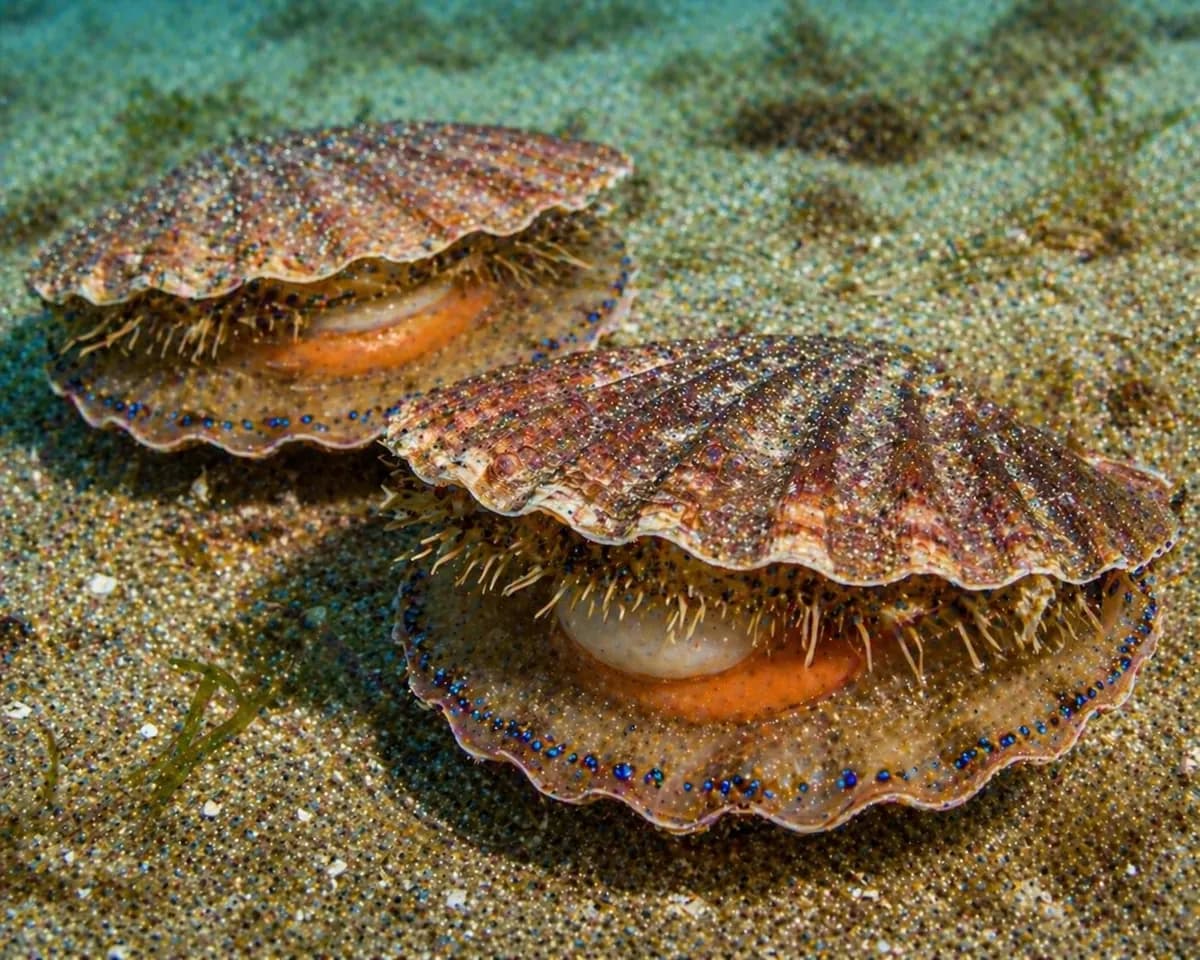
Australia's commercial scallop catch comes mainly from Bass Strait (TAS/VIC) and Hervey Bay (QLD). Roe-on, premium, and very different from imported product.

Pecten fumatus / Amusium balloti
Flavour: Sweet, milky, briny — the roe is part of the experience
Rebuilding· SAFS 2024
Australian Scallops (Pecten fumatus / Amusium balloti)

Four reasons to choose local

Health

  • Roe-on Australian scallops retain natural sweetness and nutrients
  • No water-injection or phosphate additives
  • Pristine cold Bass Strait waters

Economy

  • Bass Strait dredge fleet (TAS/VIC) supports many regional jobs
  • Hervey Bay saucer-scallop fishery key to QLD coast
  • Premium market for restaurant suppliers

Environment

  • Stock-status assessed every two years
  • Closed seasons protect spawning
  • Hervey Bay quota-managed dredge fishery

Taste

  • Roe-on is the proper way to eat them
  • Sweet, milky flesh — best raw or barely seared
  • Nothing imported comes close

Sourcing

Australian Scallops is exclusively wild-caught.

Where it comes from

Australian Scallops is most strongly associated with these 5 Australian regions:

How it's caught or grown

Production volume (last 5 years)

Total Australian annual production of Australian Scallops — wild-catch + aquaculture combined. Sourced from ABARES Australian Fisheries and Aquaculture Statistics.

Production volume (tonnes)Source: ABARES
20191,80020201,60020211,70020221,90020232,000
primary estimate

How it's managed

Commonwealth Bass Strait fishery uses rotational closures to allow stocks to rebuild.

Nutrition (per 100g)

How Australian Scallops compares to imported equivalents on the headline nutrients consumers care about.

Protein17.8g15.2g
Selenium38µg26µg
Vitamin B121.6µg1µg
Omega-3 Fatty Acids380mg240mg
Iron2.4mg1.6mg

Contaminants & price

Australian Australian Scallops compared to imported equivalents on mercury, antibiotic residues, and typical retail price. Unflagged metrics come from primary government sources (FSANZ, ABARES); synthesised numbers carry a visible tag.

Metric
Australian
Imported
Mercury (mg/kg)
0.02
0.04
Antibiotic residues
none
rare
Typical retail price (2026 Q1)editorial
$45–80/kg
$25–50/kg

From harvest to plate

Days-to-plate is one of the strongest arguments for buying Australian. Here's the typical timeline for Australian Scallops.

  1. Step 1
    Catch (dredge or dive)
    Day 0 days
  2. Step 2
    Onboard chill or live tank
    0–1 days
  3. Step 3
    Wholesale
    1–2 days
  4. Step 4
    Retail / restaurant
    2–4 days
  5. Total
    Total AUS days to plate
    2–4 days

Seasonality

When to enjoy Australian Scallops at its peak.

Janavailable
Febavailable
Margood
Aprpeak
Maypeak
Junpeak
Julpeak
Augpeak
Seppeak
Octpeak
Novgood
Decavailable
Peak Good Available Off-season

How to cook it

Four go-to preparations for Australian Scallops that respect the fish — short cooks, clean flavours, no over-doing it.

Sashimi

Slice raw, dress with citrus + sea salt + olive oil.

Pan-sear

Bone-dry, hot pan, 60 sec each side, butter + lemon to finish.

Carpaccio

Paper-thin, lemon + olive oil + capers + chives.

Asian-style

Steamed in shell, hot peanut oil + soy + spring onion.

Full recipe: Pan-seared Roe-on Scallops with Cauliflower Purée

Australian vs imported — at a glance

Roe-on Australian scallops from Bass Strait and Hervey Bay vs imported scallops from Asia, USA, and Peru — often water-injected.

Australia
Australian Roe-on Scallops
Bass Strait / Hervey Bay
🇦🇺 Local
Water injection (STPP)None
Roe retainedYes
Frozen-thawed cyclesMinimal
Stock-status reportsYes
Price per kg~$70
Overall rating: Australian Scallops score 9.3/10 — roe-on, no additives, premium.
vs
Various
Imported Scallops
Japan / China / USA / Peru
Water injection (STPP)Common
Roe retainedUsually removed
Frozen-thawed cyclesCommon
Stock-status reportsVariable
Price per kg~$45
Overall rating: Imported Scallops score 5.6/10 — often water-injected and roe-off.

Read the full comparison →

Look-alikes & how to tell them apart

Products often confused with or substituted for Australian Australian Scallops — and what to look for instead.

Imported water-injected (STPP-treated) scallops
Why confused: Sold roe-off with sodium tripolyphosphate plumping agent — pale, swollen, leak liquid in the pan.
How to tell: Australian roe-on scallops are dry-pack, smaller, and brown when seared. Treated imports are pure white and exude liquid when cooked.

The risks of the imported version

Typically imported from: Japan, China, USA, Peru — often roe-off and water-injected

  • Imported scallops often water-injected (sodium tripolyphosphate) — fake weight
  • Roe typically removed for export — texture compromised
  • Frozen-thawed product loses sweetness rapidly

See the full case against imported seafood →

How to buy it

🔍
Look for:

Look for "Australian Roe-on Scallops" or "Bass Strait Scallops" — never water-injected.

From 1 July 2026, every restaurant menu in Australia must show A (Australian), I (Imported), or M (Mixed) for each seafood dish. Read the law →

Key operators, co-ops & peak bodies

The businesses, co-operatives, and industry bodies behind Australian Australian Scallops.

Historical timeline

  1. 1981
    Bass Strait Scallop Fishery enters first major management framework.
  2. 2008
    Multi-year closures introduced in response to stock decline.
  3. 2018
    Stocks begin to rebuild under rotational closure regime.

Sources for this page

  1. SAFS 2024 Fisheries Research and Development Corporation (2024)
  2. FSANZ chemical residues Food Standards Australia New Zealand (2024)

Explore other Australian species

Scroll to browse. Each card links to a full species profile.